Every electronic product begins with an idea, but turning a circuit design into a reliable production-ready component requires many engineering decisions. Magnetic components are among the parts that often need early attention because they influence power conversion, isolation, efficiency, and PCB layout.
A transformer manufacturer works with designers throughout this process, helping bridge the gap between electrical requirements and manufacturable products. Understanding this journey allows engineers and procurement teams to make more informed development decisions.
Understanding the Design Requirements Before Development
The process usually starts with the PCB design and the electrical specifications of the target application. Engineers define input and output voltages, switching frequency, power level, insulation requirements, available board space, and thermal limits. These factors determine whether a standard magnetic component is suitable or whether a custom design is needed.
During this stage, communication between the equipment designer and the magnetic component supplier is important. Small changes in the PCB layout or circuit topology may affect winding structure, magnetic core selection, or the transformer footprint. Addressing these issues early can reduce redesign work during later development.
For projects involving power modules, automotive electronics, or communication equipment, manufacturers often review both electrical and mechanical constraints before proposing a suitable design solution.
Transformer Manufacturer Decisions Begin with Magnetic Design
Once the application requirements are confirmed, magnetic design becomes the next priority. Engineers evaluate core materials, winding arrangements, insulation structures, and expected operating conditions. The objective is to balance electrical performance with production feasibility while fitting within the available PCB space.
For compact electronic products, surface-mount technology has become increasingly common because it supports automated assembly and higher component density. Designers therefore consider package dimensions alongside electrical characteristics instead of treating them as separate requirements.
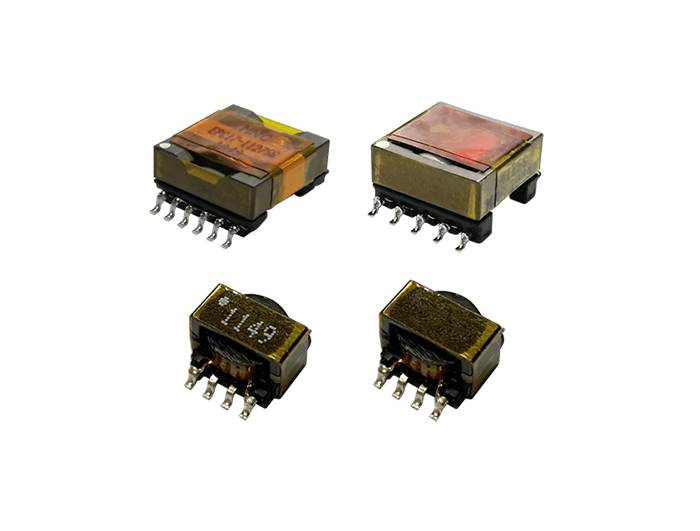
One example is the TTER09-1142SG. It uses an ER9.5 core and an SMT mounting structure, with dimensions of 12.07 mm × 10.0 mm × 6.0 mm. Its compact package makes it suitable for applications where board space is carefully managed without overlooking electrical design objectives.
Prototype Evaluation Connects Design with Manufacturing
Prototype development provides an opportunity to verify whether theoretical calculations match actual operating conditions. Electrical measurements, thermal performance, and mechanical compatibility are evaluated before production tooling begins. Any necessary adjustments can be made while design flexibility remains relatively high.
Performance verification also includes checking parameters that directly influence system reliability. For the TTER09-1142SG, the minimum inductance is 45.6 μH. The component is designed with 3000 V DC isolation and a 3 mm safety distance, allowing engineers to compare these specifications with the insulation requirements of their intended application.
Besides electrical testing, assembly compatibility is equally important. SMT components are commonly assessed for solderability, placement accuracy, and consistency during automated production, helping reduce variation when products move toward larger manufacturing volumes.
Reliability Testing Before Mass Production
After prototype verification, reliability testing helps determine whether the transformer can maintain stable performance under expected operating conditions. Depending on the application, testing may include temperature cycling, electrical endurance, insulation verification, and environmental evaluation. These assessments provide engineering data before large-scale manufacturing begins.
The operating environment is particularly important for industrial and automotive electronics. The TTER09-1142SG supports an operating temperature range from -40℃ to 125℃, making it suitable for applications exposed to significant temperature variation. It also complies with AEC-Q200 Grade 1, a qualification standard widely referenced when evaluating passive components for automotive electronic systems.
Consistency between engineering samples and production batches is another consideration. Manufacturing processes, material selection, and quality inspection all contribute to maintaining similar electrical characteristics across repeated production runs.
Preparing for Stable Volume Manufacturing
Moving from engineering samples to volume production involves more than increasing output. Production engineers review manufacturing procedures, inspection standards, SMT process compatibility, and traceability requirements before releasing a product for continuous manufacturing. These steps help improve consistency throughout the production cycle.
Automated production equipment also plays a role in maintaining dimensional accuracy and repeatable winding quality. When magnetic components are manufactured with controlled processes, equipment manufacturers can receive products with more predictable performance across different production batches.
For OEM and ODM projects, manufacturers often continue supporting customers after pilot production. Feedback from assembly lines or field testing may lead to design refinements that improve manufacturability without changing the intended electrical function.
Supporting Different Industries with Customized Magnetic Components
The development process described above applies to many industries, although the final products vary according to application requirements. Power modules, renewable energy equipment, communication infrastructure, and automotive electronics each require different combinations of magnetic components.
Besides high-frequency transformers, companies may also develop PFC inductors, common-mode inductors, differential-mode inductors, planar transformers, and molded power inductors for power conversion systems.
Automotive projects may additionally require OBC transformers, DC-DC transformers, drive transformers, BMS transformers, and filter inductors. In communication equipment, traditional LAN transformers and chip LAN transformers support different network interface designs.
As project requirements become more specialized, collaboration between system designers and component suppliers becomes increasingly valuable throughout product development.
Conclusion
From the first PCB layout to stable mass production, every development stage influences the performance and manufacturability of a magnetic component. Design review, magnetic optimization, prototype verification, reliability evaluation, and manufacturing control all contribute to the final result.
Mentech participates in this process by developing customized magnetic components for power modules, automotive electronics, renewable energy, and communication applications. Their portfolio includes products such as the TTER09-1142SG, along with a broad range of transformers and inductors designed to support different B2B engineering requirements. Mentech continues to expand its custom magnetic component capabilities while working with customers on application-oriented product development.
