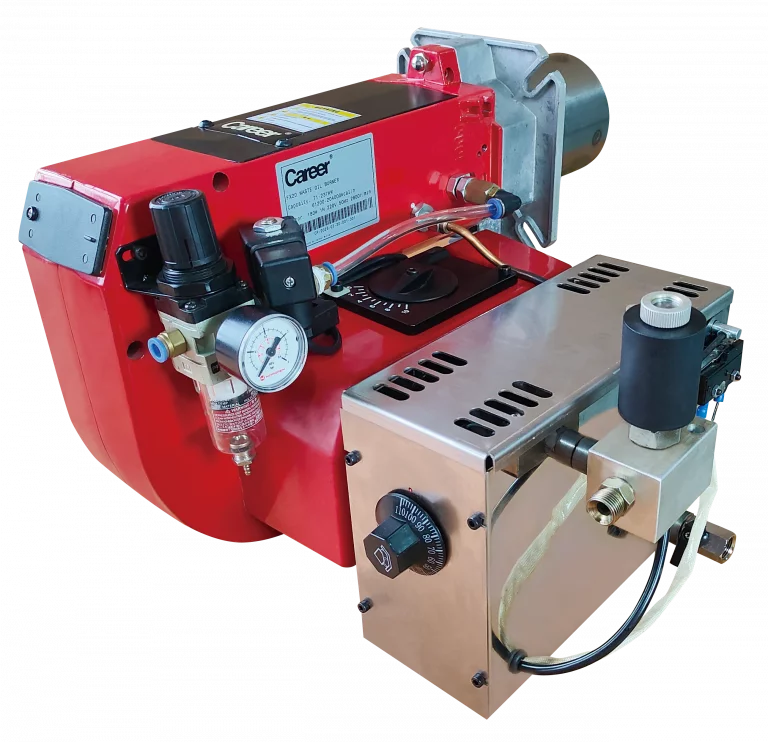
Industrial waste oil burners convert used oil into heat by preparing the liquid fuel for combustion, mixing it with combustion air, igniting the mixture, and transferring the resulting thermal energy into a furnace, boiler, heater, or other process system.
The process is more demanding than burning a clean, uniform fuel because used oil can contain contaminants and may have variable physical properties. Successful heat recovery therefore depends on proper fuel handling, atomization, air supply, ignition, and combustion control.
How Does a Waste Oil Burner Turn Used Oil Into Heat?
The basic conversion sequence is straightforward: used oil enters the fuel system, is conditioned and delivered to the burner, becomes a combustible spray or mixture, and reacts with oxygen in the combustion zone.
Heat is released during that combustion reaction. The burner then directs the hot combustion gases toward the equipment being heated, where thermal energy is transferred to the process.
Engineered for industrial heating applications, Career Burner’s waste-oil range transforms used oil into functional thermal energy, reframing the material from a disposal burden into a valuable resource.
What Happens to Used Oil Before Combustion?
Used oil cannot necessarily be handled in exactly the same way as a clean, consistent fuel. Its condition can vary according to its original use, storage, contamination, and composition.
Fuel preparation therefore forms an important part of the combustion process. Water, sediment, suspended contaminants, or other unwanted material may interfere with fuel delivery and combustion if they are not appropriately managed.
Career Burner emphasizes fuel preparation and filtration in its waste-oil burner information, reflecting the need to control the condition of the fuel entering the combustion system.
The objective is not to transform used oil into a completely different fuel. Instead, the system prepares it sufficiently for controlled delivery and combustion within the burner’s intended operating conditions.
How Is Used Oil Prepared for Ignition?
Atomization is the critical step that changes liquid fuel into a form that can mix effectively with air. A burner must break the incoming oil into smaller droplets so that the available heat and oxygen can interact with the fuel efficiently.
Fuel viscosity and temperature can influence this stage. Used oil may have different properties from one batch to another, so the burner and fuel system need to be designed around the characteristics of the intended waste-oil stream.
Career Burner’s industrial waste oil burner category identifies equipment intended specifically for waste-oil combustion, with burner configurations designed around the requirements of this fuel type.
Once properly prepared and atomized, the oil can enter the combustion zone in a condition that supports mixing and ignition.
How Does the Burner Create a Combustible Mixture?
Combustion requires fuel and oxygen to meet under suitable temperature and mixing conditions. The burner supplies combustion air around the fuel stream and establishes the flow pattern needed for the two to interact.
Air movement and turbulence influence how quickly oxygen reaches the fuel droplets. Insufficient mixing can leave fuel-rich areas, while poorly controlled airflow can disturb the flame or introduce more air than the process requires.
A used oil burner therefore performs more than a fuel-injection function. Its combustion-air system, burner geometry, ignition arrangement, and fuel-delivery components work together to establish the conditions required for sustained combustion.
Where Does the Heat Come From?
Once the prepared oil and combustion air form an ignitable mixture, the ignition system initiates combustion. The fuel then reacts with oxygen and releases chemical energy as heat.
That heat is carried primarily by the hot combustion gases leaving the flame zone. Depending on the equipment, those gases can heat furnace materials directly, transfer energy through heat-transfer surfaces, or provide hot air for another industrial process.
Career Burner lists waste-oil burners for industrial heating applications and positions waste oil as a recoverable energy source within the combustion process.
The useful output is therefore not the flame itself but the controlled thermal energy transferred from combustion into the industrial process.
How Is Combustion Controlled During Operation?
Stable heat production requires the burner to maintain an appropriate relationship between fuel delivery and combustion air. Operating conditions can change as the furnace temperature, process load, or fuel condition changes.
Controls help coordinate fuel supply, ignition, airflow, and flame supervision. Flame monitoring is particularly important because the system needs to recognize whether combustion has been established and maintained.
Career Burner describes its waste-oil burner equipment as incorporating automatic operating functions and combustion-control features suited to waste-oil firing. The exact configuration depends on the individual model and installation.
Proper adjustment also matters after installation. Fuel characteristics, burner condition, airflow, and combustion settings can influence how effectively the available fuel is converted into heat.
What Makes the Conversion Process Work Reliably?
Reliable waste-oil combustion depends on the complete sequence working together. Fuel must reach the burner in a manageable condition; the burner must prepare and atomize it; combustion air must mix effectively with the fuel; ignition must establish the flame; and controls must maintain safe, stable operation.
The used oil burner is therefore best understood as one component of a complete fuel-to-heat system. Storage, filtration, fuel delivery, combustion air, burner controls, furnace geometry, and exhaust arrangements can all influence the final result.
Rather than simply modifying traditional clean-fuel equipment, Career Burner designs its waste-oil burner range specifically for waste-oil firing, providing a dedicated solution to convert used oil into practical industrial heat.
The fundamental answer is that an industrial waste oil burner converts used oil into heat through controlled preparation, atomization, air-fuel mixing, ignition, and combustion.
Once the chemical energy stored in the oil is released, the resulting hot gases transfer that energy to the industrial process. Effective operation depends on keeping every stage of that chain compatible with the fuel and the equipment receiving the heat.
