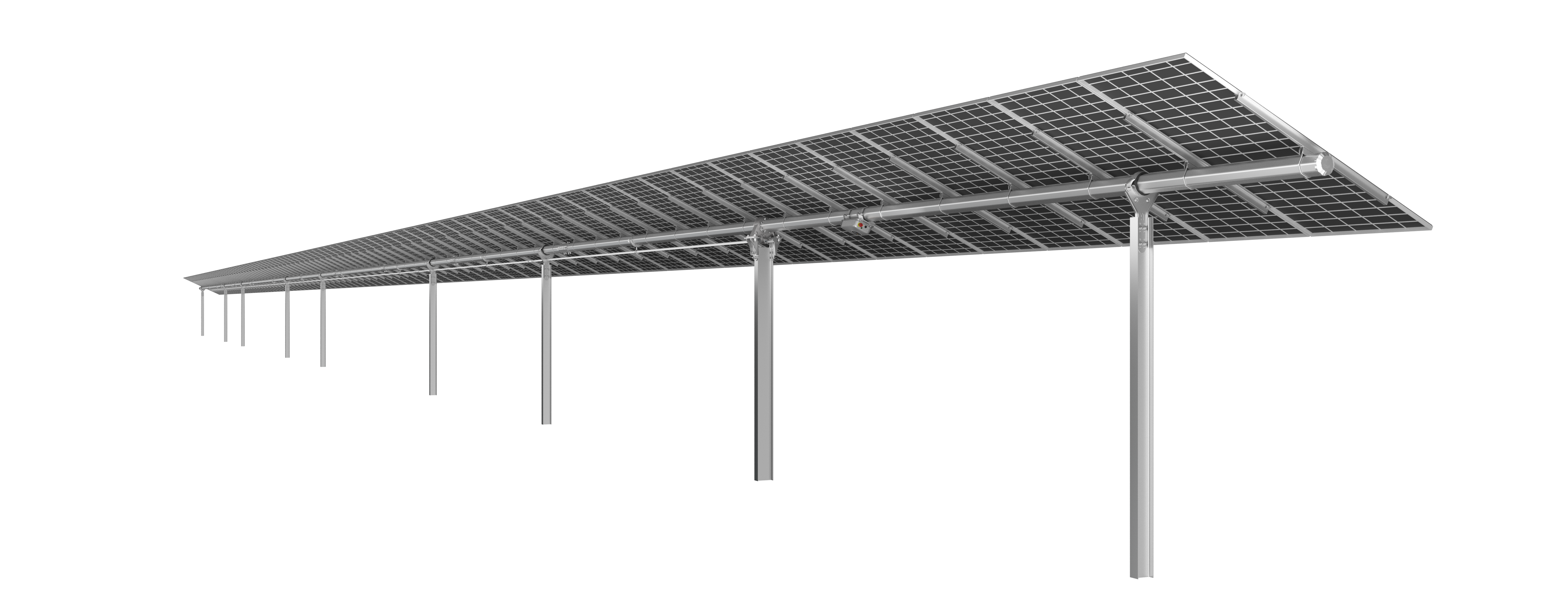
Utility-scale tracker design increasingly has to reconcile long rows, uneven terrain, high wind exposure, construction productivity, and lifecycle availability. These demands are interconnected: a lighter structure can ease logistics, but it must retain stiffness, while added articulation can follow slopes only if control and mechanical interfaces remain dependable.
Antaisolar developed AT-Spark as a multiple-slew-drive, single-axis independent 1P tracker for large photovoltaic plants. Its configuration combines a strengthened torque tube, long-row capability, terrain accommodation, pre-assembled elements, and intelligent protection features intended to address both project economics and operating risk.
Engineering the Structure for Long Tracker Rows
Longer tracker rows can reduce the number of controllers, drives, foundations, and row-end interfaces per megawatt. Their structural response is more demanding, however, because torsion, deflection, dynamic wind effects, drive synchronization, and accumulated tolerances grow with length. The design basis must use the offered row geometry and site-specific wind conditions.
An octagonal torque tube places material efficiently around the section and offers multiple controlled connection faces. Antaisolar reports that its octagonal design increases specific stiffness by 40 percent and strength by 50 percent, while enabling material-cost reductions of up to 30 percent compared with the referenced conventional configuration.
The system supports rows up to 143 meters and uses between one and six drives according to configuration. Fewer rows and optimized drive placement can cut pile quantities; the published reduction is up to 20 percent. Foundation savings still require geotechnical pull-out testing, structural reactions, refusal risk, and installation tolerances to be incorporated into the site design.
Wind qualification should connect the structural model, wind-tunnel evidence, stow angle, control thresholds, and loss-of-power response. A stated wind resistance of 70 meters per second provides a product capability reference, but each project needs verification for its code basis, exposure category, topography, row spacing, damping assumptions, and module configuration.
Adapting to Terrain and Accelerating Installation
Grading can improve tracker uniformity but adds earthwork cost, erosion risk, drainage changes, and environmental disturbance. A terrain-following system seeks to reduce those impacts by permitting controlled variation along a row. Survey accuracy remains essential because allowable articulation is not a substitute for understanding abrupt slope breaks or foundation elevation errors.
Dual-spherical bearings allow north–south slope adaptation of up to 15 percent in the published configuration. Their rotational freedom helps accommodate changes in pile elevation and alignment while transferring loads through the row. Designers should confirm bearing angles, clearance, drive locations, and module envelope throughout the full tracking range.
Installation productivity depends on more than component count. Antaisolar uses a quick-install bearing housing and reports a 25 percent efficiency improvement, while broader tracker delivery can include up to 45 percent pre-assembly. Clear row labeling, protected transport, calibrated tools, pile surveys, and defined correction procedures are needed to preserve those gains on site.
The 120-degree tracking range provides flexibility for energy capture and protective positioning. Commissioning should verify angular accuracy, mechanical limits, motor current, drive synchronization, backtracking behavior, sensor calibration, communication, and safe recovery after an interruption before rows are released for normal operation.
Protecting Energy Production Across the Asset Life
Tracker value depends on additional energy yield being sustained without excessive downtime or maintenance. Controls should account for terrain shading, bifacial response, astronomical position, weather inputs, and communication failures. Energy models need realistic availability and auxiliary consumption rather than assuming perfect tracking throughout the year.
Antaisolar’s SmartTrail platform provides four extreme-weather protection modes addressing wind, snow, and hail conditions. Protective logic should be coordinated with structural assumptions through documented trigger values, forecast inputs, sensor hierarchy, command timing, fallback positions, and restart criteria after the event has passed.
Operational visibility can come through mobile tools, onsite SCADA, and remote SCADA interfaces. Useful monitoring includes row position, command status, alarms, communication health, motor behavior, and event history. Access controls, software management, data retention, and local manual authority should be agreed before commercial operation.
AT-Spark should ultimately be assessed through project-specific calculations, certified test evidence, factory and site acceptance procedures, spare-parts planning, and measurable service commitments. That combination allows developers to test whether its structural efficiency, terrain flexibility, installation approach, and protection functions translate into dependable plant-level value.
